Wednesday, April 17, 2013

April 17 - My Grandmother Washes Her Feet in the Sink of the Bathroom at Sears


Hi again! So it seems important to retain levity without sacrificing a recognition of significance. I say recognition because, political or otherwise, isn't poetry about recognizing the significant? 

Obviously, there are plenty of books discussing what poetry is or isn't, itself kind of a silly question, but I simply mean that humor in poetry allows for a connection to real life that we can all understand. It's hard for me to stay focused on serious issues sometimes due to a constant stream of poop jokes, song lyrics and cheat codes. (Why start with Glass Joe anyway? It's not until you get to the second Bald Bull that you have to start paying attention.)

Fuck you, Mario! It was a fast count! I can see  the coins falling out of your pocket!

The poem today is by Mohja Kahf, a Syrian-American poet. She writes a lot about feminism in the Middle East as well as the various intersections and detours one must navigate in modern American culture as a woman, Muslim, Syrian and American. This is from her first book, Emails from Scheherazad, published in 2003. She currently teaches at the King Fahd Center for Middle East and Islamic Studies at the University of Arkansas.

My Grandmother Washes Her Feet in the Sink of the Bathroom at Sears

My grandmother puts her feet in the sink of the bathroom at Sears
to wash them in the ritual washing for prayer,
wudu,
because she has to pray in the store or miss
the mandatory prayer time for Muslims
She does it with great poise, balancing
herself with one plump matronly arm
against the automated hot-air hand dryer,
after having removed her support knee-highs
and laid them aside, folded in thirds,
and given me her purse and her packages to hold
so she can accomplish this august ritual
and get back to the ritual of shopping for housewares

Respectable Sears matrons shake their heads and frown
as they notice what my grandmother is doing,
an affront to American porcelain,
a contamination of American Standards
by something foreign and unhygienic
requiring civic action and possible use of disinfectant spray
They fluster about and flutter their hands and I can see
a clash of civilizations brewing in the Sears bathroom

My grandmother, though she speaks no English,
catches their meaning and her look in the mirror says,
I have washed my feet over Iznik tile in Istanbul
with water from the world's ancient irrigation systems
I have washed my feet in the bathhouses of Damascus
over painted bowls imported from China
among the best families of Aleppo
And if you Americans knew anything
about civilization and cleanliness,
you'd make wider washbins, anyway
My grandmother knows one culture—the right one,

as do these matrons from the Middle West. For them,
my grandmother might as well have been squatting
in the mud over a rusty tin in vaguely tropical squalor,
Mexican or Middle Eastern, it doesn't matter which,
when she lifts her well-groomed foot and puts it over the edge.
"You can't do that," one of the women protests,
turning to me, "Tell her she can't do that."
"We wash our feet five times a day,"
my grandmother declares hotly in Arabic.
"My feet are cleaner than their sink.
Worried about their sink, are they? I
should worry about my feet!"
My grandmother nudges me, "Go on, tell them."

Standing between the door and the mirror, I can see
at multiple angles, my grandmother and the other shoppers,
all of them decent and goodhearted women, diligent
in cleanliness, grooming, and decorum
Even now my grandmother, not to be rushed,
is delicately drying her pumps with tissues from her purse
For my grandmother always wears well-turned pumps
that match her purse, I think in case someone
from one of the best families of Aleppo
should run into her—here, in front of the Kenmore display

I smile at the midwestern women
as if my grandmother has just said something lovely about them
and shrug at my grandmother as if they
had just apologized through me
No one is fooled, but I

hold the door open for everyone
and we all emerge on the sales floor
and lose ourselves in the great common ground
of housewares on markdown.

Tuesday, April 16, 2013

April 16 - I'm Explaining a Few Things

After the bombing yesterday, I spent a lot of time last night reading poetry and drinking gimlets. I thought I might put in some Bertolt Brecht, Nazim Hikmet, Osip Mandelstam, Denise Levertov or Wislawa Szymborska, but I decided on Pablo Neruda. If you know the people I've mentioned, you can probably imagine that sitting at a bar and staring at my phone got real damn intense. (Btw, my phone is the internet, the internet is a book, but a drink is still a drink. Good.)

Reading poetry about different wars in different countries, different tragedies and different people, the common humanity of the participants comes through. It is both relieving and frightening.

I know you need to get back to work, and this poem is a little bit longer than usual, so let me give you a link to a more in-depth examination of the poem you can read if you desire. Here is something to note: Sometimes an image or experience is elucidated by metaphor, sometimes we need to have our faces firmly shoved into the reality poetry provides.

I'm Explaining a Few Things

You are going to ask: and where are the lilacs?
and the poppy-petalled metaphysics?
and the rain repeatedly spattering
its words and drilling them full
of apertures and birds?
I'll tell you all the news.

I lived in a suburb,
a suburb of Madrid, with bells,
and clocks, and trees.

From there you could look out
over Castille's dry face:
a leather ocean.
My house was called
the house of flowers, because in every cranny
geraniums burst: it was
a good-looking house
with its dogs and children.
Remember, Raul?
Eh, Rafel? Federico, do you remember
from under the ground
my balconies on which
the light of June drowned flowers in your mouth?
Brother, my brother!
Everything
loud with big voices, the salt of merchandises,
pile-ups of palpitating bread,
the stalls of my suburb of Arguelles with its statue
like a drained inkwell in a swirl of hake:
oil flowed into spoons,
a deep baying
of feet and hands swelled in the streets,
metres, litres, the sharp
measure of life,
stacked-up fish,
the texture of roofs with a cold sun in which
the weather vane falters,
the fine, frenzied ivory of potatoes,
wave on wave of tomatoes rolling down the sea.

And morning all that was burning,
one morning the bonfires
leapt out of the earth
devouring human beings
and from then on fire,
gunpowder from then on,
and from then on blood.
Bandits with planes and Moors,
bandits with finger-rings and duchesses,
bandits with black friars spattering blessings
came through the sky to kill children
and the blood of the children ran through the streets
without fuss, like children's blood.

Jackals that the jackals would despise,
stones that the dry thistle would bite on and spit out,
vipers that the vipers would abominate!

Face to face with you I have seen the blood
of Spain tower like a tide
to drown you in one wave
of pride and knives!

Treacherous
generals:
see my dead house,
look at broken Spain:
from every house burning metal flows
instead of flowers,
from every socket of Spain
Spain emerges
and from every dead child a rifle with eyes,
and from every crime bullets are born
which will one day find
the bull's eye of your hearts.

And you'll ask: why doesn't his poetry
speak of dreams and leaves
and the great volcanoes of his native land?

Come and see the blood in the streets.
Come and see
The blood in the streets.
Come and see the blood
in the streets!

Monday, April 15, 2013

April 15 - Guide to the Ruins


Guide to the Ruins

by Howard Nemerov

One lives by commerce, said the guide.
One sells the available thing, time
And again: the ruins, the temple grove,
The gods with their noses knocked off.
One profits by the view.

It is a difficult trade, he said,
To give to the dishonored dead
Their stature and their stony eyes.
The vulgar paint has flaked away
Leaving the color of time,

The unimpassioned grey which is
Not now in commodious demand.
One gives, with broken Herakles,
A premium of legend, a pamphlet
To certify the chill.

What is it that one sells, the self?
I think not. One sells always time
Dissembled in heroic stone: such eyes
As look like cloud-reflecting lakes
In the old mountains of time.


And we’re back! Hello, hello, hello and how ya doin’? I got one of my favorite new books last week: Guide to the Ruins by Howard Nemerov. It’s not at all new; it was Nemerov’s second book and was originally published in 1950.

But it’s new to me, and I can’t stop smelling this old book. The dust jacket is barely there, the binding almost disintegrated. It’s great. I love getting the actual book of poetry, not some selected works mess.

Initiate rant: I think the publishing industry isn’t doing itself a lot of favors by putting out one greatest hits collection after another for poets, especially modern(ish) ones. Poems spanning an entire career show only the great mountains and valleys that a person may reach while writing. Does this mean that there weren’t aberrations, missteps and tangents that occurred as well?

I'm saying Pulling Teeth actually makes Welcome to Paradise and Basket Case better.

Think of it this way: how many bands have great songs never anthologized? I know they exist, but how stupid are the Pink Floyd and Radiohead greatest hits albums? Even if you’re not a fan of these bands, you can understand that their albums are often fashioned as a whole, not a series of tracks. Greatest hits albums cannot include the in-between sounds, the long silences, intros, instrumentals, and epilogues. It’s kind of inherent to what they are.

And that’s not entirely a bad thing. It works for music as a way of introducing folks to new artists (same as poetry), without drowning them in the complete oeuvre. If you like what you hear, you can go listen to the album it came from on Spotify or head down to Amoeba and buy it on CD or vinyl.

Poetry doesn’t quite have that option. The industry ain’t got the same amount of money as music. (I just had an image of a Billy Collins halftime reading at the Superbowl. He looked...so spice!) Because of this, most poetry books are out of print, or require a bit of doing to get. If I want something specific, like Nemerov’s second book, I go to Amazon and find it. Order it, and hope it isn’t full of weird notes and dong doodles.

Except if it's written by Long Dong Silver

I wish I could go to a bookstore and find a neat row of books to peruse (by Nemerov, hell I'd check out Long Dong's poetry too). Sadly, there are very, very few poets with whom this is a possibility. I don’t really blame publishers for not reprinting books. I’m sure there’s not a lot of demand or money in it, but it’s just the state of things.

Anyway, it’s too bad. I wish I had lots of small books on my shelf. Instead I have all these tomes. Artifacts of an art form, not the fruits of this year and vintages of the past, replete with bruises and a bit of cork here and there.

Monday, April 8, 2013

April 8 - The Cunning Optimism of Language


Oh man, sorry about no Sunday post. Once I got back from Long Beach, my day became a series of naps and episodes of Metalocalypse. But I’m back today, right? I decided to use a poem today that I came across in The Best American Poetry 2010. For anybody out there interested in learning about some of the poetry currently being written in this country, the yearly anthology series is a friendly place to start.

Today’s poem is by Bob Hicok, a former teacher at my alma mater (though I couldn’t get into his workshop due to underclassmen late-ass registration requirements). One of my favorite aspects of Hicok’s poetry is his ability to use humor in his verse without it feeling forced or tired. Anyway, here you go.


The Cunning Optimism of Language

by Bob Hicok

She made me Overlord of the Sewers.
It was a quiet ceremony before bed, consisting of,
you are Overlord of the Sewers. I’m unsure
what my powers are, though clearly absolute,
I thought as we kissed good night. Waking
in this state, I found coffee tasted the same.
I’ve left a note to my underlings: make
everything better. I’m particularly curious
about raisin bread. How can raisin bread
be improved? Not the cheap shit
but the good stuff. This is love, I tell you,
the random bestowal of a title. Anything else
is fraudulent. Now you have something, sort of
like a tag, by which to gauge if your love is real.
As our beds will tell you, do not remove the tag
under penalty of law. Such stern cops, our beds.
Go to sleep, they tell us, make love, they tell us,
die. If your lover makes you Overlord, don’t ask,
of what? These are one-time offers, I fear,
just as the lightbulb that burned out
last night gets one chance to fail.
I have these minutes, all these chances to fail,
I must be many lightbulbs. It’s well-lit
except in the corners, this life.


I love the conversational tone of Hicok. It seems like a far cry from the vaunted language of some of the more stereotypically “poetic” poets. Hicok goes a bit of the Hemingway or William Carlos Williams route by using casual language to discuss events and themes are great importance, probably. There’s a certain mystery in everyday language here. Is it all tongue-in-cheek, or is there some larger matter beneath the crust of the raisin bread? Are you comfortable accepting both?

Saturday, April 6, 2013

April 6 - Power


Power

Living    in the earth-deposits    of our history

Today a backhoe divulged    out of a crumbling flank of earth
one bottle    amber    perfect    a hundred-year-old
cure for fever    or melancholy    a tonic
for living on this earth    in the winters of this climate

Today I was reading about Marie Curie:
she must have known she suffered    from radiation sickness
her body bombarded for years    by the element
she had purified
It seems she denied to the end
the source of the cataracts on her eyes
the cracked and suppurating skin    of her finger-ends
till she could no longer hold    a test-tube or a pencil

She died    a famous woman    denying
her wounds
denying
her wounds    came    from the same source as her power


Today’s poem is by Adrienne Rich. It was a great loss when she died just over a year ago. Here’s a link to her page on Wikipedia. Usually, poets have sort of crap biographies on Wikipedia, but hers is pretty good. She’s a real interesting life to learn.

So let’s talk about this poem a bit before I head to Long Beach. It seems to me that one of the primary studies of feminism, and for that matter most -isms, is the relationship we as ethereal neural impulses and frail, flesh-bag bodies deal with the distribution and consequences of power.

How then to begin to talk about it, but to look to the past. The first line, “Living    in the earth-deposits    of our history,” rearranges the usual idea of history, as something we find buried in the earth, I’m thinking Pompeii, for example. Instead, “earth-deposits” are found in history. Using “deposits” also denotes that earth is not present in all of our history, but exists like geodes in the crust.

Then we move on to a backhoe, not something we use normally for archaeological excavation, more of a blunt-force trauma than a brush. Anyway, we can reasonably conclude that this is some situation of earth-moving associated with construction of something new to follow, or of simply sweeping away something old. This means that unearthing the bottle is incidental to what the backhoe is there for.
An amber bottle, not unlike the amber of prehistoric tree sap, which always reminds of Jurassic Park (now back in theatres!). A preservative of whatever is inside, be it a mosquito with dino DNA or a concoction of snake oil meant to cure what ails you, from the physical (fever) to the mental (melancholy).

This panacea held great power for the people buying it, despite the fact that, in all likelihood, it at best was either a mild sedative or did nothing allowing the body or mine (placebo effect) to cure itself. At worst, it would have only exacerbated the original problem or even caused altogether new ones.

Also today, the speaker reads about Marie Curie, the famous Polish scientist responsible for the discovery of radium, radon, polonium and numerous other scientific advances. Here’s how important she,and her French husband, Pierre, are: Curium is the ninety-sixth element on the periodic table. It’s one thing to have a random species of animal named after you, but an element? I mean, that’s big time. She’s up there with Einstein, California and Thor.

Curie made her discoveries prior to our understanding of the harmful effects of radiation, and as such eventually died from radiation poisoning. In fact, her notes, even her cookbook, are still kept in lead-lined boxes because they are still too radioactive for a human to handle without protection. On that note, “suppurating” means discharging pus or festering, that’s makes for an awkward handshake.

In order to maintain her public standing as a great scientist, she had to deny the danger of the discovery she had made. Perhaps because the male-run scientific community would have found a way to refute the importance of the work because she, as a woman, had made a mistake?

So what is power? Does it come from within or without? Are we powerful because others agree we are powerful? Maybe it is a more personal state. We can see from the pairing of the bottle with Marie Curie that there is power in the thing, or external, such as the bottle as artifact and in its own time as remedy as well as Curie’s international renown as a scientist and a person capable of refusing the tragic effects of radiation poisoning.

Power is also internal. It is not the amber of the bottle that was important to patients, it was what it preserved that mattered. Is the same true for Curie and her decimated mortal form?

This is both true and not true, I believe. Rather than get philosophical, let’s take a look at the actual text of the poem. Lines are broken midway by spaces while other words, which can exist independently, are forced together by hyphens to form something new. The language is at once separated and conjoined. OK, I have to catch a train to Compton. Ack! No time for proofreading, but I’ll check it on the light rail.

Friday, April 5, 2013

April 5 - San Onofre, California


So, my original plan for today didn’t work out for reasons that are singular and stupid. Anyway, I’ll have it ready by Monday. In trying to come up with something new, I realized I’ve yet to post anything by a female poet, which is total bullshit on my part and I apologize.


Considering I took a poem from an anthology put together by Carolyn Forche, and the fact that she is one of our best living poets as far as I am concerned, I’m going to talk about a poem included in her second book of poetry, The Country Between Us. The poem appears in the section of the book titled “In Salvador, 1978-1980.” The title of the poem is a beach a bit north of San Diego and the U.S.-Mexico border.


San Onofre, California

We have come far south.
Beyond here, the oldest women
shelling limas into black shawls.
Portillo scratching his name
on the walls, the slender ribbons
of piss, children patting the mud.
If we go on, we might stop
in the street in the very place
where someone disappeared
and the words Come with us! we might
hear them. If that happened, we would
lead our lives with our hands
tied together. That is why we feel
it is enough to listen
to the wind jostling lemons,
to dogs ticking across the terraces,
knowing that while birds and warmer weather
are forever moving north,
the cries of those who vanish
might take years to get here.


I love the use of enjambment in this poem. Enjambment, so I can sound smart, is when a poet chooses to end a line prior to when the reader would expect. It can create surprise, tension, multiple meanings, and even humor. e.e. cummings was one of the best enjambers (which is also the perfect name for a basketball team made of poetry MFAs).

Take “Slender ribbons / of piss” as an example. By enjambing this, we at first imagine slender ribbons, pretty things we’d see at a party or celebration with ribbons hanging from the wall mentioned at the beginning of the line. Of course, our image is greatly changed by the words “of piss.” Now we are left to imagine the parabolas and tangents of urine humans create, made all the more jarring by the joyful scene we had begun to construct.

OK, lemme jump back from technical stuff. What we have just read is one of my favorite examples of how to make a political poem without being overly political. Politics is something we are constantly affected by in at least a passive way. I’m not going to go into too much detail, but suffice it to say that our lives are political lives.

One of the strengths of this poem, to me, is its ability to discuss the politics of the time and place without leaving the realities of our lives. We are all always affected by politics, but for the people of this poem, politics has become an active, fickle, dangerous and shadowy intruder.

The first image of this poem, “the oldest women shelling limas into black shawls,” does a wonderful job of being quotidian and ominous at the same time. Full Disclosure: I had to look up what a lima was, but am so glad I did. (If you have a smartphone, I highly recommend the Dictionary.com app.)

Clams, yo.

A lima, as evinced by “shelling,” is a kind of clam. However, the word itself is, in a kind of roundabout way, a Spanish corruption of an Incan word meaning “to speak.” This goes back to the history of the Peruvian capital, and the use of language by those in power.

The oldest in Korea can still speak Japanese, the oldest Vietnamese can still speak French. I knew a guy from Azerbaijan and woman from Ukraine whom spoke Russian to each other.

Despite what may be a bit of a stretch, this idea that the oldest women are literally disarming speech and tucking it into black fabric creates an immediate image of death and censorship thriving just below the surface of food and prosperity, and not unlike how a clam lives inside a shell and just under the surface of the sand.

Oh my, I could write about this poem all night. Considering it’s Friday, I ain’t got no job, I ain’t got no money, and I got shit to do, I just may. I’ma abruptly end here.

Thursday, April 4, 2013

April 4 - Forced March


Try this: Finish the poem and reflect on it a bit before reading the bio. Then read the bio and see how your understanding changes. Is it enhanced? Tainted?


Forced March

The man who, having collapsed,       rises, takes steps, is insane:
he’ll move an ankle, a knee,       an arrant mass of pain,
and take to the road again       as if wings were to lift him high;
in vain the ditch will call him:       he simply dare not stay;
and should you ask, why not?     perhaps he’ll turn and answer:
his wife is waiting back home,     and a death, one beautiful, wiser.
But see, the wretch is a fool,       for over the homes, that world,
long since nothing but singed       winds have been known to whirl;
his housewall lies supine;       your plum tree, broken clear,
and all the nights back home       horripilate with fear.
Oh, if I could believe       that I haven’t merely borne
what is worthwhile, in my heart;       that there is, to return, a home;
tell me it’s all still there:       the cool verandah, bees
of peaceful silence, buzzing,       while the plum jam cooled;
where over sleepy gardens       summer-end peace sunbathed,
and among bow and foliage       fruits were swaying naked;
and, blonde, my Fanni waited       before the redwood fence,
with morning slowly tracing       its shadowed reticence....
But all that could still be—       tonight the moon is round!
Don’t go past me, my friend—       shout! And I’ll come around!


Been thinking a bit more about the contextualization problem of posting these poems. On the one hand, I worry about detracting from the work itself by bogging it down with “facts.” For example, if I said a poet were right handed, then posted a poem in which the speaker eats a taco with his or her left hand, you might end up focusing on that fact rather than the obvious symbolism for the taco (tacos always mean the economy, duh).

Of course, I can go the art gallery approach. Am I the only one who is always bothered by the fact that most museums and such only provide you with a little white card saying the title, year of creation and the materials used? As a non-painter, I always feel a bit cheated by lack of information. Maybe that’s how they make their headphone tour money.

I ain't examining nuthin', I'm just waiting for a spot to open up on the damn bench.

J.R.R. Tolkien detested the idea that an artist’s life would be required to understand an artist’s work. This has apparently made getting tourism to his old home a bit tough on the local city council. In fact, if you think of the Lord of the Rings universe nowadays, you’re probably imagining somewhere in New Zealand. But shouldn’t a work of art be able to stand alone? We do plenty fine with lots of works created simply by Anonymous.

The most-best solution I can figure is to stay flexible. Sometimes shit needs a little ‘splaining before you toss a reader into the deep end. Other times, a bit of drowning is what’s required.

by flickr user Kables
Remember to move closer to the water before letting go. Ulysses is tough enough without broken legs.


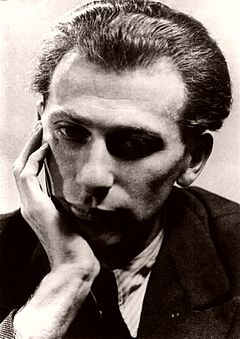
Today’s poem is “Forced March” by Miklós Radnóti (translated by Emery George). I’ll give you some biographical info on him and the poem afterwards. You will, of course, have noted that the poem is way back at the top. The first sentence of this paragraph is the first mention of the poet himself. Anyway, instead of writing a bio myself, Carolyn Forché has done a much better job than I ever could, so I’ll use hers. Also, I should note, the poem as I found it is from her fantastic anthology, Against Forgetting: Twentieth Century Poetry of Witness, which I highly recommend, and from which this bio also is taken (I’m sure I’ll be taking more out of there before the month is over).


Miklós Radnóti (1909-1944)


Radnóti, orphaned by age eleven, enrolled at the University of Szeged in 1930, the year his first book of poetry appeared. For his second book, Radnóti was tried for “effrontery to public modesty and incitement to rebellion,” and found guilty, whereupon his books were confiscated. He was called to forced military labor intermittently from 1940 until his death. In 1944 he was sent to Yugoslavia to construct a railway, but was force-marched with three thousand other men back to Hungary because of the advancing Red Army. In early November 1944, Radnóti and twenty other survivors of this march were put in the hands of Hungarian noncommissioned officers, who, unable to place their charges at a local hospital, shot them. Radnóti’s body was exhumed from a mass grave in 1946. His widow, going through his pockets, discovered a notebook full of poems, which included “Forced March,” “Letter to My Wife,” “Picture Postcards,” and “Seventh Eclogue.”